
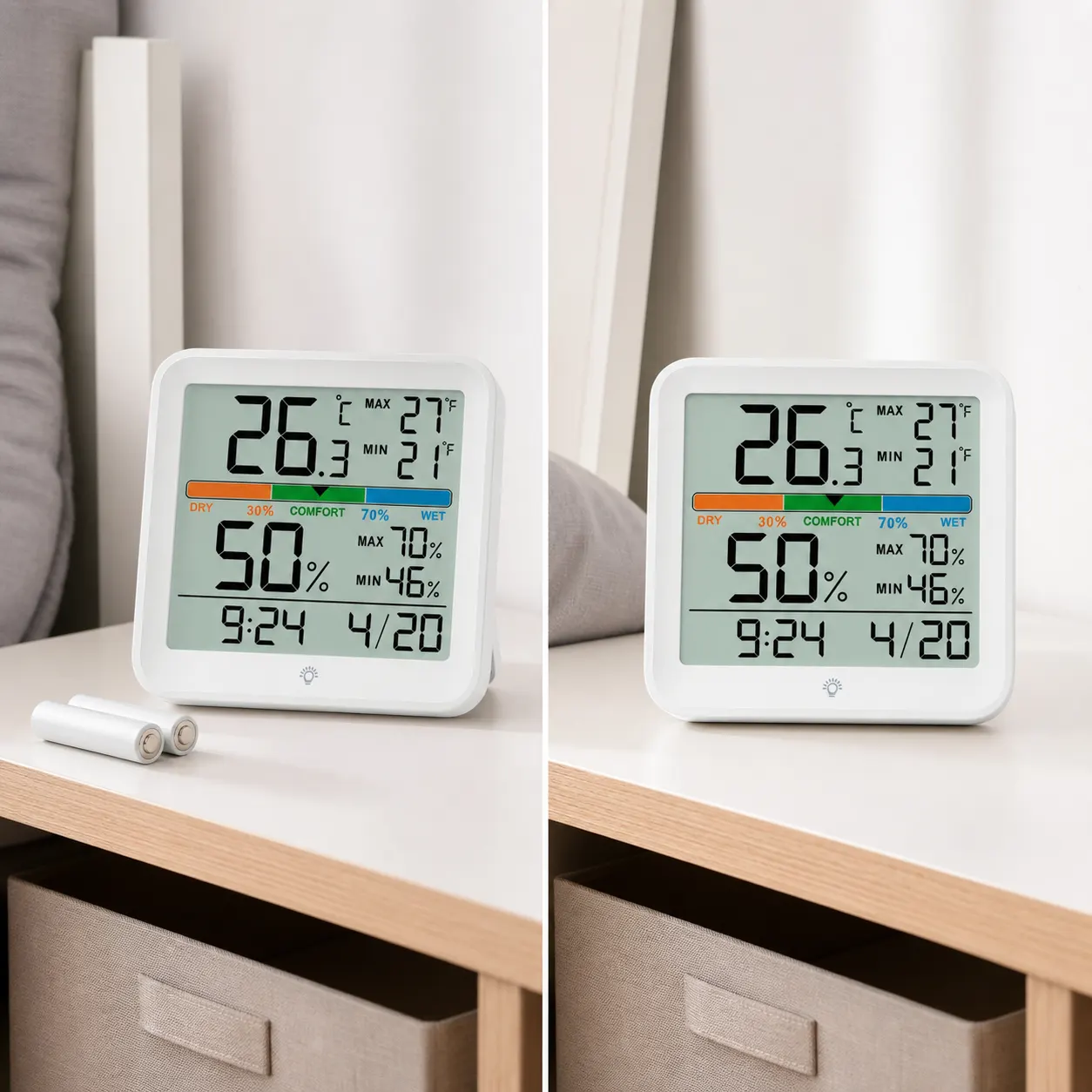
Short answer: A digital humidity monitor for a bedroom is useful when you want a visible reading to compare room conditions over time, but it is not a diagnosis of damp or mould. The YGH5275 listing describes a Classic White colour-screen unit with indoor temperature and humidity display, calendar and clock, a stated 10% to 99% RH range, and two AAA 1.5 V batteries. It does not publish accuracy, calibration status, data logging, alarm thresholds or sensor-placement instructions. Choose it for simple room monitoring only when those limits fit the decision you need to make.
What the YGH5275 listing actually confirms
The product page identifies the item as a Classic White YGH5275 colour-screen indoor thermometer and hygrometer. It describes an indoor temperature and humidity display with a calendar and clock, and publishes a 10% to 99% RH measurement range.
Those facts answer the basic product question, not every bedroom-monitoring question. Manufacturer does not specify accuracy, calibration method, response time, memory, app support, alarm limits, wall-mounting method or a clinical or building-diagnostic purpose.
| Published point | What remains unconfirmed |
|---|---|
| 10% to 99% RH range | Accuracy, repeatability and calibration |
| Indoor temperature and humidity display | Remote alerts, logging and export |
| Two AAA 1.5 V batteries | Battery life and low-battery behaviour |
How to use a bedroom reading sensibly
Use the display as a consistent observation point. Put it where the air around the sleeping area is representative, keep the location consistent between readings, and record what changed in the room such as ventilation, drying clothes or a closed door. The product page does not specify a required placement distance from windows, radiators, bathrooms or walls, so do not invent one.
A reading is evidence about the air at that place and time. Government guidance explains that condensation damp forms when moisture generated inside the home cools and condenses on colder parts of a building. A monitor can help you notice a pattern, but it cannot identify a leak, quantify a building defect or replace an inspection.
- Check the display and battery state before starting a comparison.
- Record the room, approximate time and relevant activity beside the RH reading.
- Compare like-for-like readings before changing several ventilation or heating variables at once.
- Investigate persistent damp or mould separately instead of treating one display value as a diagnosis.
Bedroom buying checks that matter
The two AAA 1.5 V battery requirement is clear on the listing, so confirm that this suits the intended room and your maintenance routine. The display includes a clock and calendar, but the listing does not confirm a backlight duration, night readability, audible alarm or stored minimum and maximum values.
If the buyer needs a certified building survey, continuous records, a remote notification or a verified accuracy band, this listing does not provide those capabilities. Manufacturer does not specify them. That is a reason to select a different documented instrument, not a reason to fill the gap with a guess.
- Buy when a local display and stated RH range are enough for the monitoring decision.
- Pause when accuracy, calibration or a formal record is required.
- Treat recurring condensation, visible mould or suspected leaks as a separate property issue.
Limits before you order
This is a room-monitoring purchase, not proof of a safe or healthy bedroom. The product page does not state that the YGH5275 diagnoses damp, mould, respiratory conditions or building defects. It also does not state an ingress-protection rating, service life or replacement sensor policy.
For a straightforward bedroom comparison, the documented display and battery facts may be enough. If the decision depends on a number that must be traceable, calibrated or remotely recorded, manufacturer does not specify the required evidence and the product should not be presented as meeting it.
Related guides and product details
Order only if a local display and the stated RH range match your use; ask for documented accuracy and logging evidence when those details control the decision. Read Indoor Thermometer Hygrometer UK: Check the Specification for related guidance. Read Room Humidity Monitor for Condensation: Use the Reading Carefully for related guidance. Review the documented specification on the YGH5275 colour-screen indoor thermometer and hygrometer, classic white product page before ordering.
Sources and safety context
- Supports the model, display, published RH range and battery facts. YGH5275 product page.
- Supports the explanation that condensation damp forms when indoor moisture cools and condenses on colder building surfaces. Damp and mould in the home.