
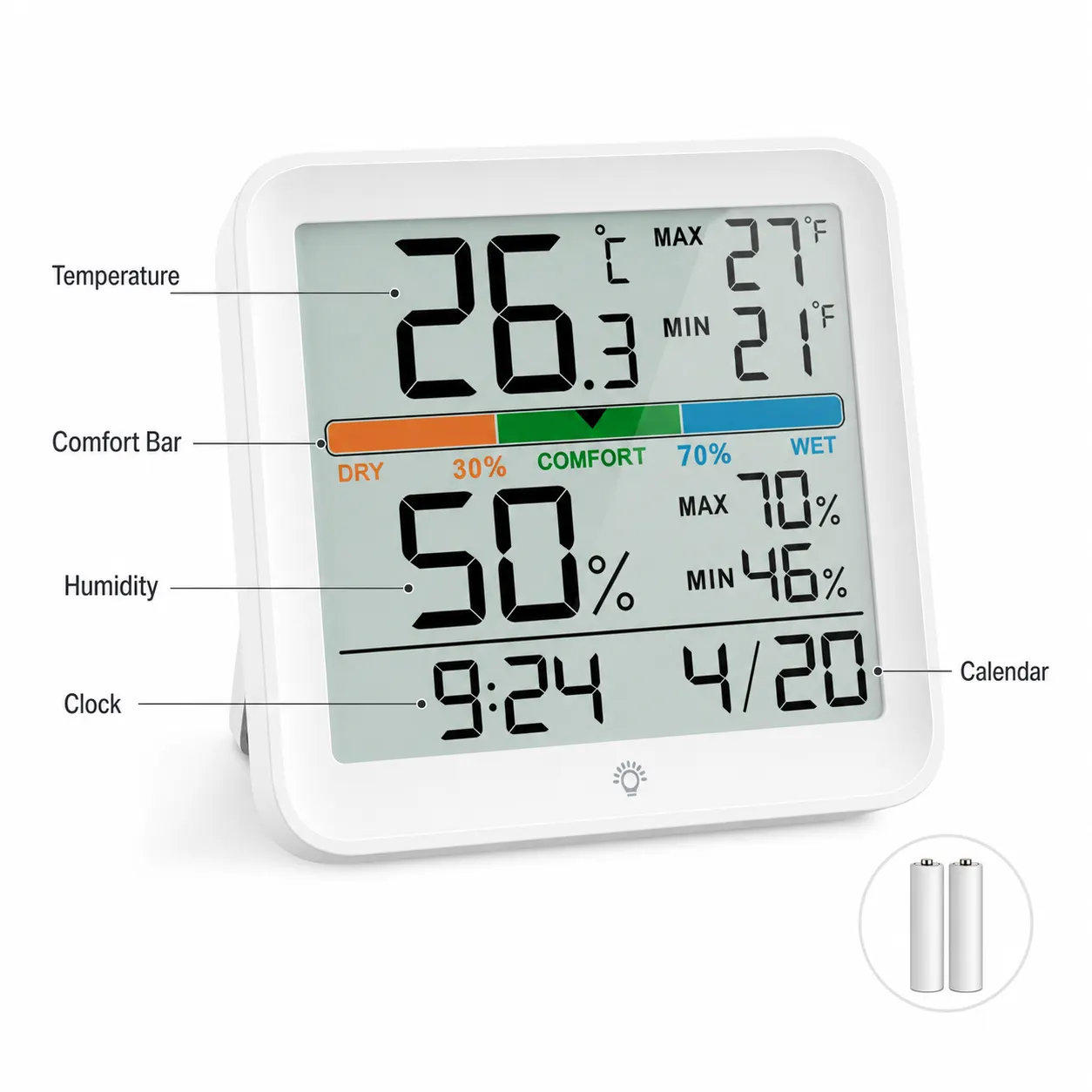
Short answer: An indoor thermometer hygrometer for UK rooms should be judged by the measurement job, the published specification and the limits that remain unknown. The YGH5275 product page describes a Classic White colour-screen device that displays indoor temperature and humidity alongside a calendar and clock. It states a temperature range of 20 to 60 degrees Celsius, a humidity range of 10% to 99% RH and two AAA 1.5 V batteries. Manufacturer does not specify accuracy, calibration, logging, alarms or environmental protection, so the right choice depends on whether a simple local display is enough.
Read the specification without adding claims
The YGH5275 is listed as a Classic White colour-screen indoor thermometer and hygrometer. Its published functions are an indoor temperature and humidity display with calendar and clock. The stated ranges are 20 to 60 degrees Celsius for temperature and 10% to 99% RH for humidity.
A range is not an accuracy claim. Manufacturer does not specify the error band, calibration procedure, stabilisation time, data interval, display resolution, sensor type or whether readings are intended for compliance work. Keep those gaps visible when comparing products.
| Question | Published answer | Unknown |
|---|---|---|
| What does it display? | Indoor temperature, humidity, calendar and clock | Logging, app and remote alert functions |
| What ranges are stated? | 20 to 60 degrees Celsius and 10% to 99% RH | Accuracy and calibration |
| What powers it? | Two AAA 1.5 V batteries | Runtime and battery warning behaviour |
Match the instrument to the room
For a living room, bedroom or home office, a local display can support a repeated observation routine. Place it consistently, note the time and room conditions, and avoid comparing a reading beside a radiator with one beside a cold window as if they were the same sample. The product page does not prescribe a placement method.
Government guidance links condensation damp with moisture generated inside the home cooling and condensing on colder building surfaces. That makes room context important, but it does not turn this display into a survey instrument or a mould test.
- Define the decision: routine observation, condensation investigation or a formal measurement requirement.
- Check that the target room conditions sit inside the published temperature and RH ranges.
- Take comparable readings from a consistent location and record notable room activity.
- Escalate building defects or persistent mould separately from the purchase of a display.
UK buyer checks before checkout
The battery configuration is clear, but the listing does not confirm whether batteries are included, how long they last or whether the unit retains settings after replacement. It also does not state an ingress-protection rating, wall-fixing method, cable probe, remote sensor or replaceable sensor.
If a workplace, landlord, insurer or contractor needs a traceable measurement, ask for the missing documentation before ordering. Manufacturer does not specify an accuracy certificate or calibration interval for this listing. Do not borrow those details from a different thermometer or hygrometer.
- Use the product page as the source for the YGH5275 model and its published ranges.
- Use the room and building context to interpret a reading, not to invent a pass or fail threshold.
- Choose another documented device if alarms, records, calibration or remote access are essential.
What this product cannot prove
The listing does not say that the device diagnoses damp, mould, indoor-air quality or a health condition. It does not state that a displayed value proves a room is safe, dry or free from a building defect.
It also does not publish a service-life estimate or compatibility with an external sensor. A careful UK purchase therefore rests on a modest promise: a visible local temperature and humidity display within the stated ranges, powered by two AAA 1.5 V batteries.
Related guides and product details
Choose the YGH5275 when its simple local display and stated ranges cover the job; require separate evidence for calibrated, logged or alarmed measurements. Read Room Humidity Monitor for Condensation: Use the Reading Carefully for related guidance. Read Digital Humidity Monitor for a Bedroom: What to Check for related guidance. Review the documented specification on the YGH5275 colour-screen indoor thermometer and hygrometer, classic white product page before ordering.
Sources and safety context
- Supports the model, display functions, ranges and battery configuration. YGH5275 product page.
- Supports the condensation explanation and the boundary between a room reading and a building investigation. Damp and mould in the home.