
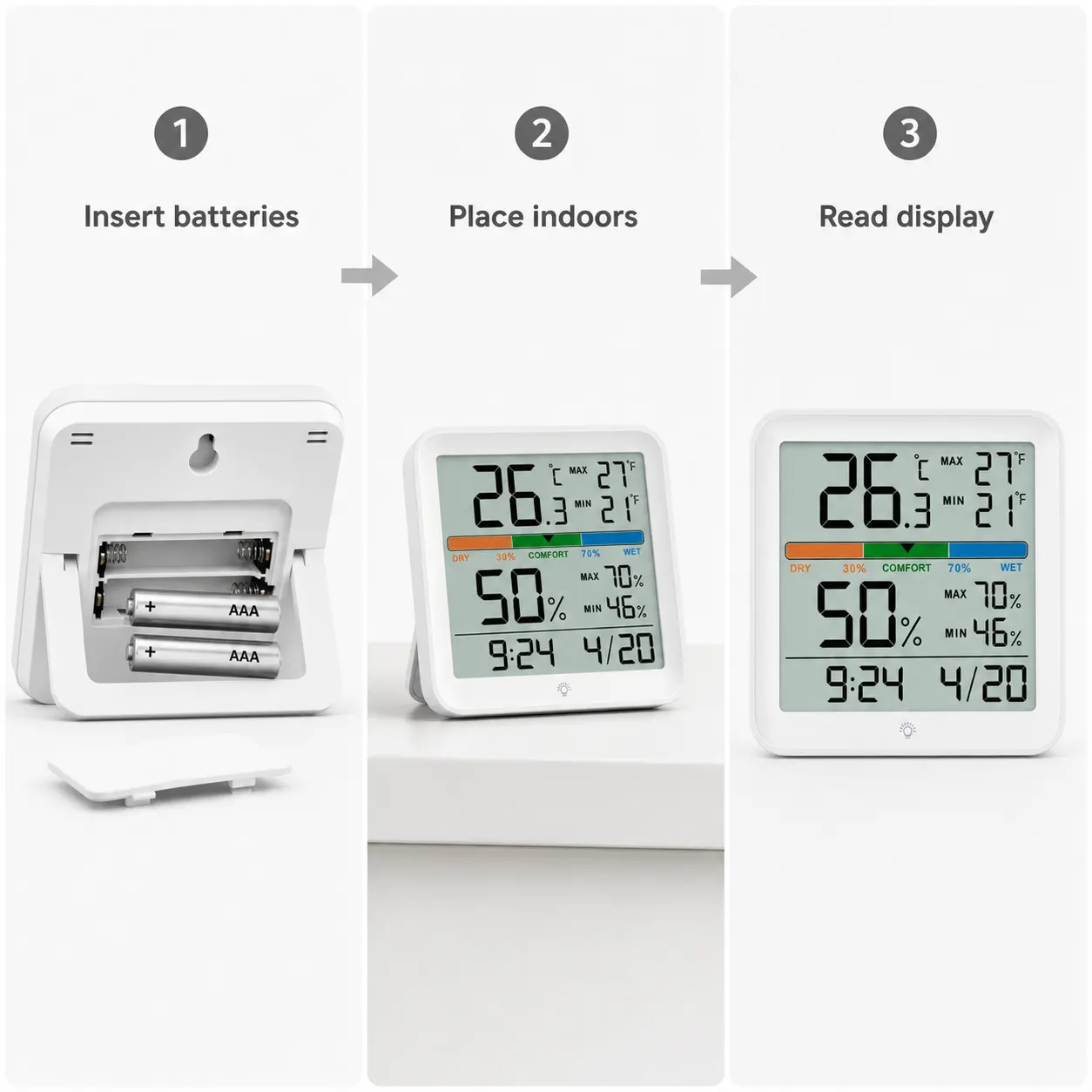
Short answer: A room humidity monitor can help you observe conditions around condensation, but it cannot by itself explain why a wall, window or ceiling is wet. The YGH5275 listing gives a local indoor temperature and humidity display, a 10% to 99% RH range, a 20 to 60 degrees Celsius temperature range, calendar and clock functions, and two AAA 1.5 V batteries. Government guidance describes condensation damp as indoor moisture cooling on colder building surfaces. Manufacturer does not specify accuracy, alarms or a building-diagnostic function, so use the reading as context rather than a verdict.
What a humidity monitor can and cannot show
The product page describes the YGH5275 as an indoor thermometer and hygrometer with a colour-screen display. It publishes 10% to 99% RH and 20 to 60 degrees Celsius ranges, plus a calendar and clock. Those details make it suitable to consider as a local observation tool.
They do not establish that the device can diagnose condensation, predict mould or certify a room. Manufacturer does not specify accuracy, calibration, alarm thresholds, logging, sensor placement or a building-inspection purpose.
| Observation | Do not infer |
|---|---|
| RH is high at the display | The source of damp has been found |
| RH changes after ventilation | A building defect has been repaired |
| The display is within range | The reading is calibrated or certified |
A practical condensation observation routine
Government guidance states that condensation damp happens when moisture generated inside a home cools and condenses on colder building parts. A sensible routine therefore pairs the display with notes about the room and visible surfaces. Record where the unit sat, when the reading was taken and whether cooking, bathing, drying clothes or ventilation had recently changed the air.
The listing does not tell you how far the monitor should be from a wall, window or heat source. Use a consistent location and document it rather than presenting an invented placement rule as a product specification.
- Choose one representative location and note it beside each reading.
- Record temperature, RH, time and any moisture-generating activity.
- Look for repeated patterns across comparable days instead of reacting to one number.
- Arrange a property or maintenance assessment when damp persists or the cause is unclear.
Checks for a UK household purchase
The YGH5275 requires two AAA 1.5 V batteries according to the product page. The same page does not state battery life, a low-battery warning, a remote probe, memory, app connection or audible alarm. Those omissions matter if the monitor will be left unattended or used to trigger an intervention.
Do not describe a display range as a recommended household target. If a tenancy, insurance or remediation decision requires documented measurement, manufacturer does not specify the traceability or calibration evidence needed for that use.
- Keep the instrument location consistent so the readings are comparable.
- Treat visible mould, leaks and damaged surfaces as maintenance issues, not display errors.
- Ask for documented accuracy or choose a different instrument when a formal record is required.
Limits, unknowns and responsible advice
A room monitor can make a pattern easier to see, but it cannot prove that ventilation alone will solve condensation or that a room is free from health risk. Government guidance concerns the building and moisture conditions; it does not certify this product.
The product page also does not specify service life, protection against water ingress or replacement sensors. The honest buying boundary is therefore narrow: use the YGH5275 for a local reading within its published ranges, and seek the right building or professional advice for the cause of persistent damp.
Related guides and product details
Use the monitor to record a pattern, then address the building question separately; do not buy it expecting a mould diagnosis or a guaranteed condensation cure. Read Digital Humidity Monitor for a Bedroom: What to Check for related guidance. Read Indoor Thermometer Hygrometer UK: Check the Specification for related guidance. Review the documented specification on the YGH5275 colour-screen indoor thermometer and hygrometer, classic white product page before ordering.
Sources and safety context
- Supports the product identity, display, published ranges and battery requirement. YGH5275 product page.
- Supports the explanation of condensation damp and the need to separate readings from building causes. Damp and mould in the home.